
Before you scroll
- Bitcoin is a digital currency recorded on a public blockchain kept by thousands of independent computers, with no company or bank in charge.
- Its supply is capped at 21 million coins; new coins are issued to miners at a rate that halves roughly every four years.
- Price moves are large and unpredictable, and control of the private key is control of the coins.
What is Bitcoin? It is the first cryptocurrency: a way to hold and send value over the internet without a bank, using a public ledger that anyone can check and nobody controls. It was launched in 2009 by a person or group using the name Satoshi Nakamoto, whose identity is still unknown.
How the Bitcoin network works
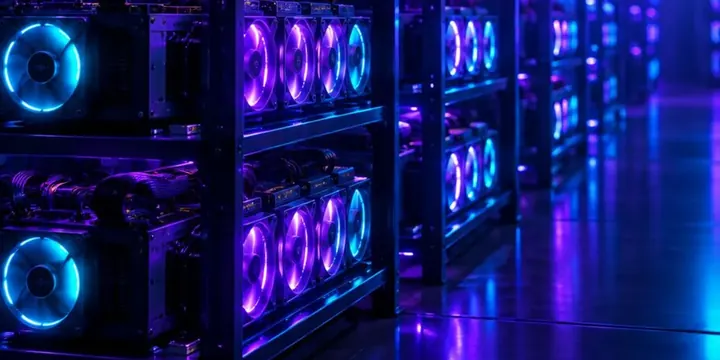
Every Bitcoin transaction is broadcast to a network of computers (nodes) that each keep a full copy of the ledger. Miners gather waiting transactions into a block and compete to find a number that makes the block's cryptographic fingerprint meet a difficulty target. The winner adds the block to the chain and receives the block reward plus the transaction fees. The difficulty adjusts so that a new block arrives roughly every ten minutes on average, however much computing power joins.
This process, called proof of work, makes rewriting history extremely expensive: an attacker would need to redo the work for the blocks in question faster than the rest of the network combined. It is also why Bitcoin uses a great deal of electricity, a point of real public debate.
Supply, mining and the halving
The rules allow a maximum of 21 million bitcoins. New coins enter circulation only through block rewards, which are cut in half every 210,000 blocks, roughly every four years. Halvings took place in 2012, 2016, 2020 and April 2024, when the reward fell to 3.125 BTC per block. The next is expected around 2028.
3.125 BTC × 144 blocks ≈ 450 BTC a day (after 2024)
1.5625 BTC × 144 blocks ≈ 225 BTC a day (after the next halving)
The figures above use the ten-minute average (144 blocks a day); the real count varies from day to day. A fixed, declining issuance schedule is often described as making Bitcoin scarce. Scarcity alone does not set a price, though: that depends on how many people want to hold it, and why.
Bitcoins and satoshis
One bitcoin is divisible into 100 million units called satoshis (sats). You do not need to buy a whole coin. For illustration, if bitcoin were priced at $80,000, a $50 purchase before fees would buy 0.000625 BTC, which is 62,500 satoshis.

Sending and receiving bitcoin
A bitcoin address is a string of letters and numbers derived from a public key. Modern addresses often start with bc1, while older formats start with 1 or 3. To receive bitcoin, you share an address; to send, you sign a transaction with your private key and broadcast it to the network.
Each transaction pays a fee to miners, and the fee depends on how much space the transaction takes in a block and how busy the network is, not on the amount sent. Sending $20 or $20,000 can cost the same. When blocks are full, transactions paying higher fees are picked first, and a low-fee payment can wait for hours. Once a transaction is in a block, most services wait for further confirmations before treating it as final.
The same caution applies as with any crypto: check the address character by character, send a small test for large amounts, and remember there is no chargeback. Bitcoin is also its own network, so sending it to an address on a different blockchain can mean losing it.
What Bitcoin is used for
In practice, most people treat bitcoin as something to hold in the hope that it will gain value, sometimes described as digital gold. Others use it to move value across borders, particularly where local banking is expensive or restricted. It is also available through regulated funds in some countries, which let investors hold price exposure through an ordinary brokerage account rather than managing keys. Each route carries different costs and protections: a fund adds management fees but removes custody decisions; an exchange account is convenient but depends on the platform; a self-custody wallet removes the middleman and adds the responsibility.
For everyday shopping, bitcoin has been slower to catch on. Price swings make it awkward as a unit of account, and fees rise when the network is busy. Layer-two systems such as the Lightning Network aim to make small payments quicker and cheaper by settling many of them off the main chain.
Holding bitcoin safely
Bitcoin is controlled by private keys. Held on an exchange, the exchange controls the keys and you hold a claim on it. Held in your own wallet, a recovery phrase is the master copy of your access. Lose it and nobody can restore the coins; reveal it and someone else can take them.
- Write the recovery phrase on paper or metal; never photograph it, store it in email or type it into a website.
- Buy hardware wallets only from the manufacturer or an authorised seller, never second-hand or pre-configured.
- Be wary of any support agent, app or "wallet validation" page that asks for your phrase. None of them needs it.
Why the price swings so much
Bitcoin produces no earnings, pays no interest and has no central bank to steady it. Its price reflects supply and demand from investors, traders and institutions, and it reacts to interest rates, regulation, flows into funds that hold bitcoin, and sentiment. Falls of more than 50% from a previous high have happened several times. Anyone who says they know where the price is going next is guessing.
If you are looking at a possible purchase, the crypto profit calculator shows how fees on both sides of a trade move your break-even point.
Bitcoin scams to recognise
- Doubling giveaways: videos or posts, often using a famous person's face, promising to send back twice what you send. Nobody sends anything back.
- Mining contracts and "cloud mining" with fixed daily payouts that are paid from new deposits until they stop.
- Bitcoin ATM demands: callers posing as officials or bank staff who tell you to "protect" your savings by depositing cash into a crypto ATM.
- Fake trading platforms that show profits on bitcoin you never actually own.
Our scam guide explains how to check each of these. For the technology in general, see how crypto works.
Readers also ask
Who controls Bitcoin?
No single party. Changes to the rules require broad agreement among the people who run the software, and the ledger is kept by thousands of independent nodes.
What happens when all 21 million bitcoins are mined?
Block rewards will have fallen to zero, expected well over a century from now, and miners will be paid only through transaction fees.
Is Bitcoin anonymous?
It is pseudonymous. Addresses are not labelled with names, but every transaction is public, and exchanges that verify identity can link addresses to people.
Sources
- Bitcoin protocol documentation and consensus rules
- UK Financial Conduct Authority, ban on crypto-derivatives for retail consumers (2021)